

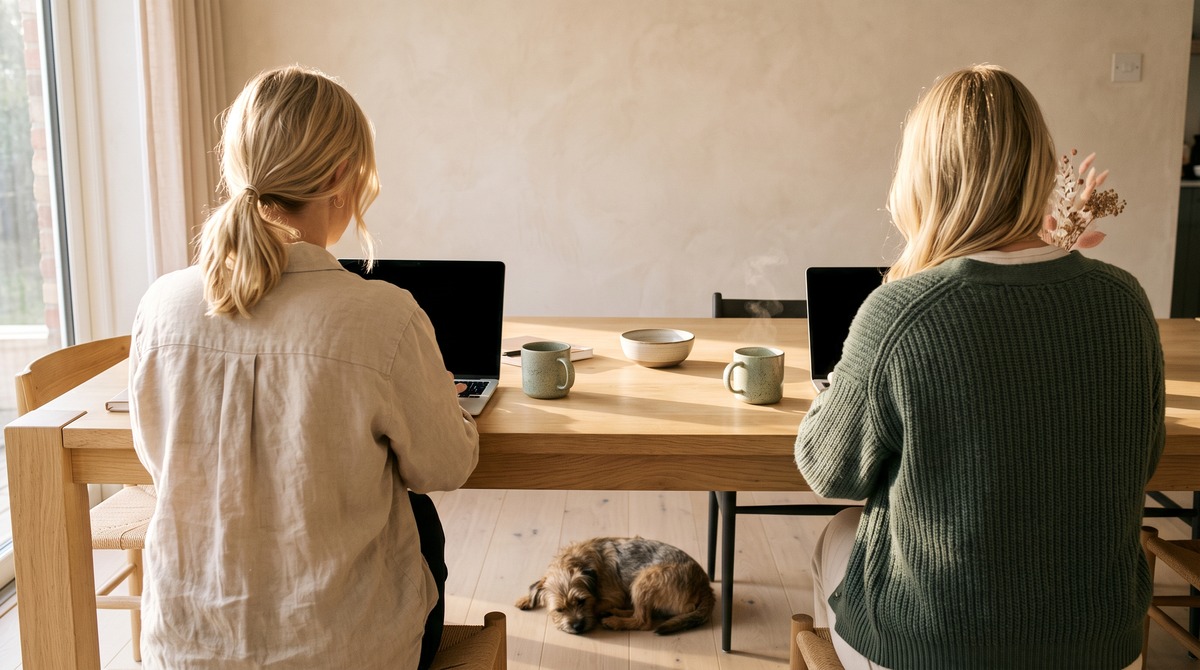
A body double is another person nearby while you work. They do their own thing, they don’t help, and they don’t check on you. For a lot of brains, mine included, their presence makes a task easier to start and easier to stay inside. It doesn’t work on every task or for every person. Some jobs go better with company and some need complete silence, and figuring out which is which for you is the useful part.
Why does having someone nearby help you start?
The plainest explanation is borrowed motion. Starting a task from a dead stop is the expensive part, and another person in the room is already moving, so some of your start comes free. I wrote about the same mechanic in why you can’t start even when you know the next step, where body doubling shows up as one item on a bigger list. Joining something in motion asks less of you than generating motion from stillness.
There’s a quieter piece too. A person nearby makes the task feel accompanied without making it feel watched. Nobody’s grading you, but wandering off to your phone has a little more friction than it does when the house is empty.
And if you like the woo framing, people talk about the energy of a room all the time. This is one place you can test it without believing anything in advance. Put a person in the room, work, and see what happens.
When does body doubling work? My scorecard so far
I don’t usually do it on purpose. I noticed it backwards, by seeing which tasks only go well when someone’s around.
Cleaning is the clearest one. If my husband cleans the house at the same time I do, I’m more focused and the whole thing is more enjoyable. Same rooms, same chores, completely different experience.
Recording videos is the bigger one. My sister helping me with my Amazon Influencer videos is amazing. Without her there, I can get paralyzed. With her in the room, the filming happens. She’s not always holding the camera and she’s not telling me what to say. She’s there, and there turns out to be enough. She often DOES help plan and hold the camera too, though.
Computer work next to my sister is a sometimes. Two laptops, same table. Some days it’s more productive and some days it’s not, and the difference is the task, which took me a while to notice.
When does body doubling backfire?
For me, whenever the task is major brain work. Writing needs complete silence. I can write alone all day and never miss the company, and a person in the room while I’m writing costs me focus instead of adding any.
The strangest version was a group I worked with a few years ago who loved video coworking sessions. Cameras on, everyone working. On paper, body doubling at scale. In practice I was a deer in headlights. Being loosely near one person helps me, and being visibly on camera with a group froze me solid.
So the same me, in the same week, needs company for filming and silence for writing. Nobody can hand you your version of this list. You find it by trying things.

What’s parallel play, and is it the same thing?
Parallel play is the relaxed cousin: two people sharing space during downtime, each content doing their own thing, neither one needing anything from the other. My husband downstairs watching TV while I’m upstairs reading is one of my favorite states of the house. Nothing’s wrong, and nobody’s being ignored. We’re both where we want to be.
It runs in reverse on me too, and this part is worth knowing about yourself. I can’t relax while someone else is working around me. If my husband is out doing yard work, there’s no version of me lying on the couch. I’ll be up and doing something within minutes, whether or not anything needed doing. The sync happens on its own, in whichever direction the other person is pointed. Body doubling is what it looks like when you aim it at a task on purpose.
How do you find out which tasks need company?
Test one task at a time, the same way I tracked my energy to find out what charges me. Guessing about yourself is unreliable. Small experiments aren’t.
- Pick one task you keep avoiding. Chores, filming, paperwork, listing things to sell.
- Do it once with someone around who’s doing their own thing. Not helping, present.
- Do it once alone, and notice which version was easier to start and which one you stayed in longer.
- Move to the next task, and expect a mixed scorecard. Mine is mixed too.
Substitutes count as versions worth testing. A podcast works for me on some tasks, as long as it doesn’t want my full attention. My three dogs count for something, since the house never feels empty with them in it. I also talk to myself all day. I say “Help” out loud a surprising number of times, to nobody in particular. The dogs stopped reacting a while ago.
If you track habits somewhere, note which days the avoided task happened and who was around. I use my own tracker, Dopamine Dealer, and a week of check marks answers the question faster than memory does.

Today’s action
Set up one body-doubled attempt at something you’ve been avoiding.
- Pick one task you keep putting off.
- Ask one person to be around while you do it. The ask is small: “Keep me company, you don’t have to help.”
- If nobody’s available, put on a podcast or take the task to wherever someone already is.
- Afterward, write one line: easier, harder, or no different.
Frequently asked questions
Does body doubling only work for people with ADHD?
No. It comes up most in ADHD conversations because task initiation is often the hardest step for ADHD brains, and body doubling targets starting specifically. But borrowed motion helps plenty of people without a diagnosis, which is why coffee shops full of laptops exist.
Can a pet be a body double?
Partially. A pet gives you the not-alone part, and for some tasks not-alone is the whole ingredient. What a pet can’t supply is the working-alongside-you part, so if your sticking point is staying with a task rather than starting it, a human tends to work better. My three dogs are excellent company and mediocre coworkers.
Does virtual body doubling work?
It depends on the format, so test it before committing to one. A quiet one-on-one call where you both work suits some people fine. Group video coworking with cameras on turned me into a confused meerkat, and I only learned it by being in one. Cameras add a watched feeling, and watched is the opposite of what this is for.
What if being watched makes me freeze?
Then keep the presence and remove the watching. A body double isn’t a supervisor, so pick setups where nobody can see your screen or your progress: same house but a different room, a call with cameras off, or someone absorbed in their own project across the table. If it still feels like a performance, shrink the audience to a podcast.
What’s the difference between body doubling and parallel play?
Body doubling is company while you work on something you’d avoid alone. Parallel play is sharing space during rest, with no task involved, like one person reading while the other watches TV. The same nervous-system sync powers both, and knowing you like one doesn’t tell you much about the other.
Why can’t I relax when someone else is cleaning?
Because the sync runs both directions. Another person’s activity pulls you toward activity, which is the whole engine of body doubling, and it doesn’t switch off just because you wanted a rest day. If you need real rest, take it somewhere their motion can’t reach you, like a different floor of the house. A body double is a person nearby while you do the thing, and whether it helps depends on the task. Company for chores and filming, silence for writing, in my case. Yours will be different, so run the experiment instead of taking anyone’s word for it, mine included. Pick tonight’s avoided task, borrow a person, and see how the start feels.
A book I made
The Lightest One
An undated ADHD daily book that never asks you to prioritize. Dump everything in your head, mark each thing light, medium or heavy, and do the lightest one.
Get the paperback →I run an affiliate program on the tools I build. Approved affiliates earn 20% on what their referrals pay, for up to a year. US only for now. See the program →