
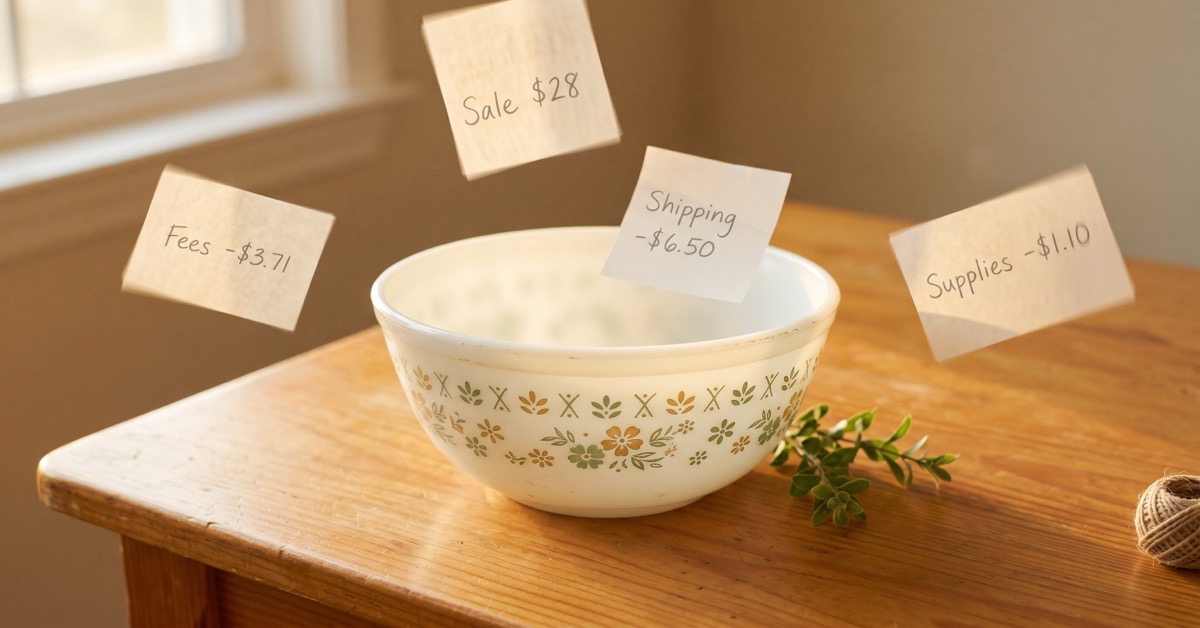
I bought a vintage Pyrex bowl at a yard sale for $4. I listed it on eBay for $32. It sold for $28 after I accepted a Best Offer. My brain did the math: $28 minus $4 = $24 profit. Nice flip.
Then I added the rest of the line items. Shipping cost $6.50. eBay’s final value fee took 13.25% ($3.71). I’d used $1.10 in bubble wrap and a small box. I’d spent about an hour total photographing, listing, packing, and getting to the post office.
Real take-home on the flip: $4.48. At my self-billing rate of $15/hour, I’d technically lost money on my time.
I’d been doing this wrong for months.
This is the trap the Flip Calculator is built to expose. You enter what you paid, what it sold for, the platform fees, shipping, supplies, and how long the flip took. The tool shows you your real profit, your margin, and your effective hourly rate. The sticker profit you started with is usually a third of what you walk away with.
Heads up: some links in this post are affiliate links, which means I may earn a commission if you sign up, at no extra cost to you. I only point to tools I actually use.
Why does sticker profit lie to almost every flip?
Sticker profit is what I used to calculate. Sale price minus what you paid. It ignores everything else.
- Platform fees (10-20% for most marketplaces)
- Payment processing sometimes bundled in, sometimes separate
- Shipping (you pay it, even if the buyer reimburses)
- Supplies (boxes, tape, bubble wrap, polybags)
- Mileage to the post office, the thrift store, the yard sale
- Time spent photographing, measuring, listing, answering questions, packing
The first three add up to 25-35% of the sale price on most platforms. The last three are invisible but they’re the difference between “this flip is worth doing” and “I just paid myself $4 an hour to lose my Saturday.”
What does each platform actually take in 2026?
The Flip Calculator pre-fills 2026 fee rates for the major reselling platforms. Sample averages:
| Platform | Final value fee | Payment fee | Other |
|---|---|---|---|
| eBay | 13.6% in most categories | included | $0.30 under $10, $0.40 over |
| Poshmark | 20% (under $15: flat $2.95) | included | seller-paid shipping discount |
| Mercari | 10% flat | included | none |
| Depop | none for US sellers | 3.3% | $0.45 per order |
| Facebook Marketplace | 0% (local) or 5% (shipped) | 2.9% if shipped | none |
| Etsy | 6.5% sale + 3% payment | $0.25 listing | $0.20 listing renewal |
The eBay, Poshmark, Mercari and Depop rows were checked against each platform’s own help pages in August 2026. Depop dropped its selling fee for US sellers entirely and Mercari moved to a flat 10%, so if you learned these rates a couple of years ago, two of them have changed under you. I broke all four apart properly in Mercari vs Poshmark vs eBay vs Depop.
These rates shift every year. Adjust them in the calculator to match what your platform is taking today.
The seed I almost stopped planting
Reselling is one of my real seeds. I’ve been doing it on and off for years. When I first ran the real profit numbers, I almost quit. Half my flips were break-even or worse. I lose interest in it all the time, but I am also a treasure-hunter at heart, so I come back.
But knowing the real number is a gift, not a sentence. It tells me which categories to keep flipping (vintage Pyrex, branded purses, decorative tins) and which to stop chasing (cheap clothing, anything under $15, anything heavier than 2 lbs without a brand premium). My yes-pile got smaller. My profit per hour went up. My weekends got better.
You can’t course-correct a seed if you can’t see what it’s returning. Manifestation people say “track your wins.” Reselling math is the most concrete version of those words.
Today’s seed: run your last 3 flips through the calculator
Pick the last 3 items you sold on any platform. Run each one through the Flip Calculator. Include the time spent. Look at your effective hourly rate. If any flip paid you less than $5/hour, the category goes in the “stop” pile.
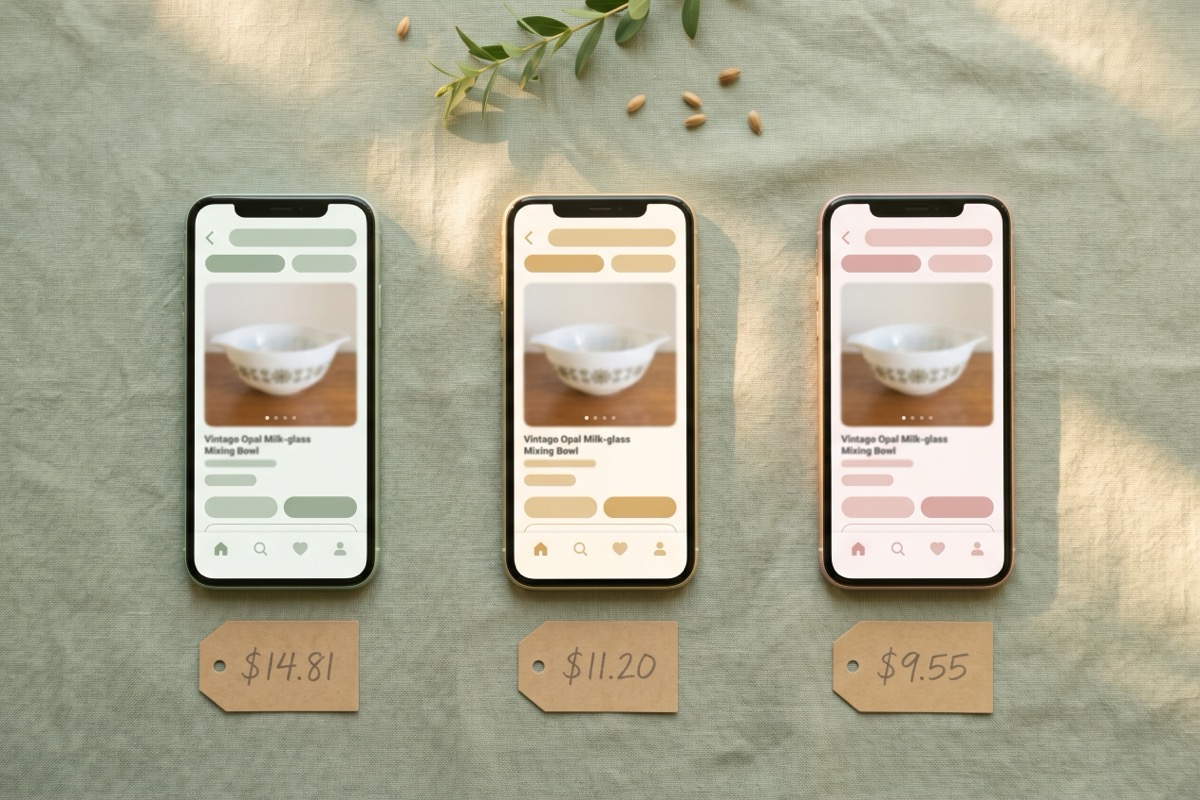
One item, three platforms, three different real profits
The same $4 vintage Pyrex bowl, listed on three platforms with realistic outcomes for each. The sticker profit looks similar. The real profit doesn’t.
| Item: Vintage Pyrex bowl, $4 thrift find | eBay | Poshmark | Mercari |
|---|---|---|---|
| Listed price | $32 | $30 | $30 |
| Sale price (after offers) | $28 | $25 | $25 |
| Platform fees | $3.71 | $5.00 | $3.23 |
| Shipping (paid by me) | $6.50 | $0 (Posh ships) | $4.00 |
| Supplies | $1.10 | $1.10 | $1.10 |
| Time at $15/hour (1 hr) | $15 | $15 | $15 |
| Real profit | $4.48 | $3.90 | $5.67 |
Mercari edges the others because shipping splits with the buyer. Poshmark’s higher fees make it the worst on a single-item sale. eBay lands in the middle.
The lesson isn’t “always sell on Mercari.” The lesson is run the math for YOUR item on YOUR platform before you list.
Time is the line item that sinks most of these numbers, so if you list the same item across several platforms, a crosslisting tool turns that hour into one listing instead of five.

Frequently asked questions
How do I calculate reselling profit correctly?
Real reselling profit = sale price minus (platform fees + shipping you paid + supplies + your time × hourly rate) minus the original cost. The Flip Calculator runs this for you in 30 seconds. I calculated sale price minus cost only for months, which is sticker profit, not real profit.
What fees should I include in profit calculations?
Include every fee the platform takes (final value fee, payment processing if separate, listing fee), every cost you pay (shipping label if not reimbursed, supplies like boxes and tape), and the time you spent (multiply by what your time is worth, even $10/hour). Skip taxes you collect for the buyer, since those flow through to the IRS, not your wallet.
What’s a good profit margin for reselling?
A healthy reselling margin is 30-50% of your sale price after all costs. Under 20% means you’re working for free once time is included. Above 60% is usually possible only with vintage, branded, or niche items bought far below market value. The Flip Calculator shows your margin in real time so you can spot which categories are profitable enough to keep doing.
Should I include my time in the profit calculation?
Yes, when you want the truth about whether a flip paid you. Casual flippers skip the time line because it’s uncomfortable. Including time at even $10/hour shows you immediately which items are paying you and which are paying you negative money. Items under $15 sale price almost never pencil out when time is included.
What platforms does this Flip Calculator work for?
eBay, Mercari, Poshmark, Depop, Facebook Marketplace, and Etsy with 2026 fee rates pre-filled. The percentages are editable, so it works for any platform if you know its fee structure. For Craigslist or free local sales, set platform fees to 0%.
When should I walk away from a flip?
When the real profit is under $5 and your time investment is over 30 minutes. Or when the effective hourly rate drops below your stated rate. The exception is high-volume low-margin items (a stack of identical T-shirts) where the time per unit is much lower than a unique item. Run the numbers before you buy at the thrift store, not after the listing sits for two months.
What this looks like when it works
You stop chasing low-margin items. You raise your minimum sale price. You start photographing 5 items at once instead of one at a time. Your effective hourly rate climbs from $4 to $18 over six months without you working more, you’re just working smarter on better seeds.
The dollars you earn flow into the Side Hustle Garden, where they cover your smallest bills first. Real profit into a real tracker. Both numbers visible. No guessing.
And if you like seeing your whole flip history in one place, I showed how I built a reselling profit dashboard with Airtable over on my other blog.
Luck favors the ones who run the math. Sticker profit is hope. Real profit is what shows up in your bank account.
Today’s action: 3 recent flips, 5 minutes per flip in the calculator, identify your most-profitable category and your least-profitable one. Lean into the first. Walk away from the second.
A tool I built
Side Hustle Garden
Log every side hustle payment and watch it knock out your monthly bills, smallest first.
Plant your first dollar →I run an affiliate program on the tools I build. Approved affiliates earn 20% on what their referrals pay, for up to a year. US only for now. See the program →